
Types of hearing aid
Almost everyone comes in asking for the smallest one you have. It is a fair question with an awkward answer: the smallest is not always the one that will work for you.
- Makes
- GN, Demant and Phonak
- Before choosing
- Free hearing assessment
- Quote
- In writing, to take away
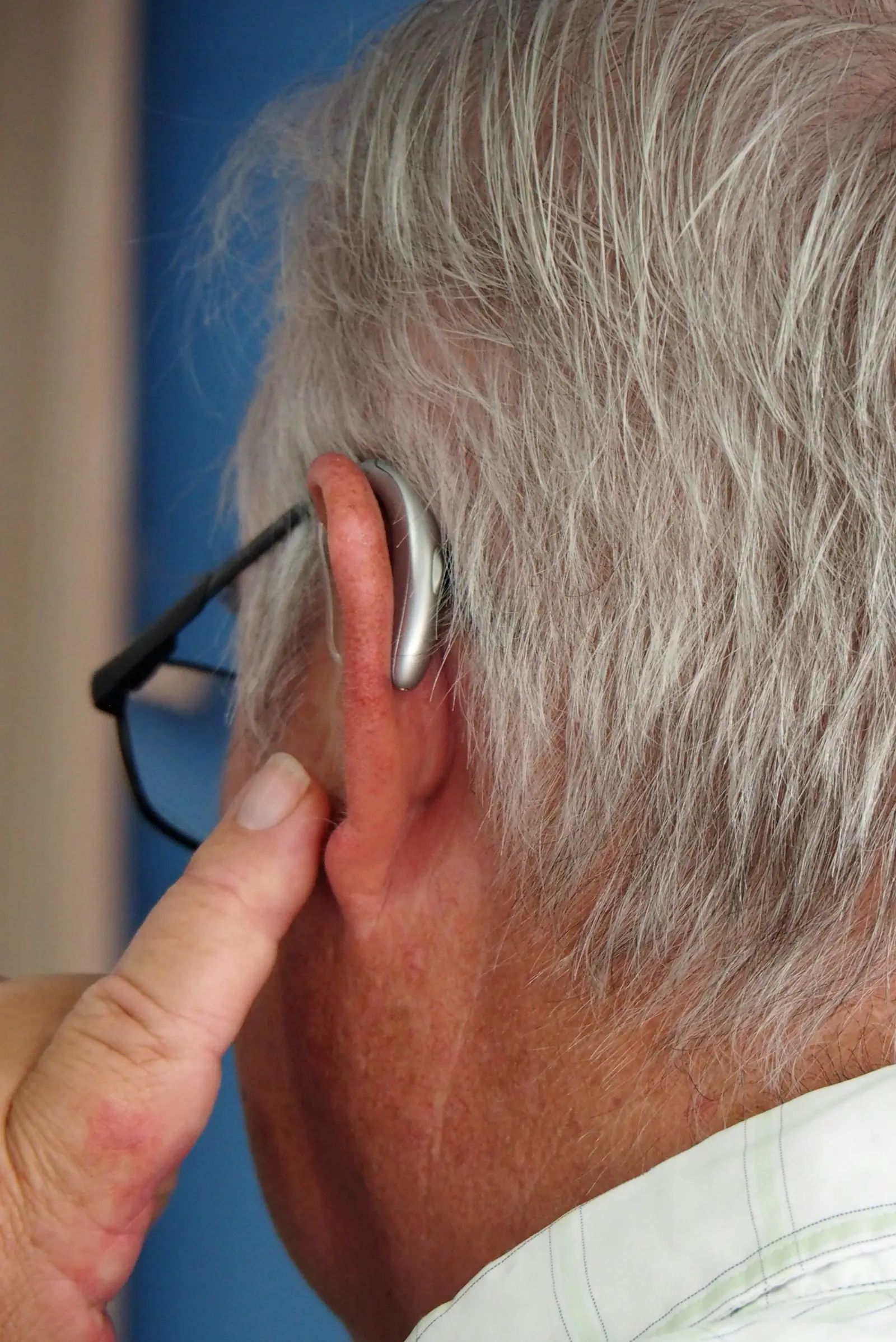
Discreet, yes. But they have to work for you first
The trade has been selling the same line for twenty years: nobody will notice, completely invisible. It is the easiest promise to make and the one most often taken apart at the first appointment.
Whether a hearing aid shows depends on two things that are down to neither you nor us: the shape and size of your ear canal, and how much amplification you need. A narrow or sharply bent canal will not take certain models. A substantial loss will not fit into a tiny device without it starting to whistle.
What we can tell you is this. A modern behind-the-ear aid is a slim shell in a skin or hair colour with a clear wire. It gives far less away than twenty years of asking people to say that again.
The ones that sit behind the ear
RIC and BTE, in the trade’s shorthand. The electronics stay behind the ear and all that goes into the canal is a very fine wire with a receiver on the end, or a tube with a mould.
It is what gets fitted most often now, and not out of habit. There is room for a rechargeable cell, room for separate microphones that help in noise, repairs are simpler, and one device covers a mild loss or a severe one by changing the receiver or the mould.
- They cover everything from a mild loss to a profound one
- Most of the range is rechargeable now, with no battery to change every week
- They suit stiff or clumsy fingers: there is more of them to hold on to
- The custom mould is made here, in our own workshop
The ones that sit inside the ear, and what nobody tells you
These are the in-the-ear and in-canal styles, down to the ones that sit deep and out of sight. Where the ear takes them they are an excellent answer: they use the shape of the outer ear to place sound, and they do not get in the way of your spectacle arms.
Now the part the advertising skips. It is worth reading before you ask for the smallest one in the cabinet.
- They give less power: past a certain loss they whistle, and no adjustment fixes it
- The smallest ones are rarely rechargeable, so a tiny battery needs changing every few days
- They live in earwax and damp, so they fail more often and need cleaning more often
- Inserting them, removing them and changing that battery takes eyesight and a steady hand: with arthritis or poor vision they end up in a drawer
- Here you also have to reckon with sweat and salt air eight months of the year
What really decides which one you get
The choice comes out of the audiogram and out of your life, in that order. We arrive at the conversation with the test already done, and you arrive with what we cannot know: where you struggle and what you can actually manage.
- Which frequencies have gone and by how much, which sets the ceiling on power
- The shape of your ear canal, which the camera shows us on day one
- One ear or two, according to what each side measured
- The state of your hands and your eyes, which is what decides whether a device gets worn
- Where the loss bothers you: in a restaurant, at church, on the phone, with the grandchildren
- What you want to spend, said by you rather than guessed by us
Multi-brand, and why that is in your interest
We work with the GN group (Beltone, ReSound and Interton), the Demant group (Oticon and Bernafon) and Phonak. In a single-brand centre the catalogue is closed before you walk in. Here it is not — and if nothing we carry suits your loss, finding the answer is our job.
It also means the quote you take home can be compared. It is written down, with the model, what is included and what is not. Show it to your family, or take it to another centre and compare. We would rather you did.
Common questions
Are they completely invisible?
That depends on the model and on your ear canal. We cannot guarantee total invisibility in every ear. What we do instead is show you at the first appointment which models genuinely fit you and how they will look, with a mirror and no flannel.
What does a hearing aid cost?
It depends on the style and the technology, and the range is wide. We do not publish prices because a price with no audiogram in front of it means nothing. After the assessment you get a written quote to take home.
Do I need one or two?
The test says, ear by ear. Where the loss is on both sides, fitting both usually helps you tell where a sound came from and follow a conversation in noise. If one ear is fine, we are not going to sell you two.
Can I listen to them before I decide?
Yes. They are programmed to your own results and you hear them in the booth with the environment simulation running: a restaurant, the street, the beach. Home trial periods we discuss at the appointment, because they vary by model and we would rather not print a figure here that turns out not to apply to you.
What about batteries and servicing?
They are part of the quote conversation, with what is included and what is not, in writing. Filters, tubing, replacement earmoulds and check-ups are explained before you sign anything, not afterwards.
The information on this site is for general guidance and does not replace a professional consultation. If you have symptoms, please see your optometrist, hearing aid audiologist or doctor.
