
About us
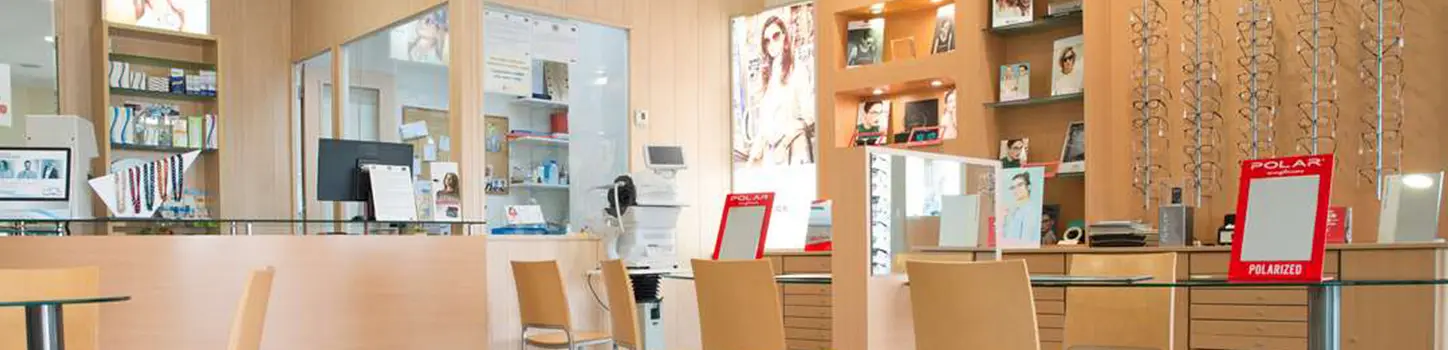
An optician’s on Calle Hernán Cortés for more than thirty years, with its own hearing centre for more than twenty-five. There are three of us in one shop, and one of the three looks after you from start to finish.
- Optician’s
- 30+ years
- Hearing centre
- 25+ years
- Team
- Three people
Who stands behind it
The owner is María Jesús Pérez García. The optician’s has been open on this street for more than thirty years, and she set up the hearing centre more than twenty-five years ago to round out what was already being done here on the optical side.
There are three of us: two optometrist-audiologists and an optical assistant. Whoever tests your eyes is the person who fits your hearing aids, and the same person is still here when you come back two years later to have them adjusted.
We publish no awards and no client numbers. What can be checked is what sits inside the shop and what is done with it, and that is what the rest of this page is about.
What we mean by fitting a hearing aid
There are hearing centres whose job begins and ends with putting a device on your ear. Ours is to deal with how you hear, and that includes telling you that you do not need hearing aids on the day you do not need them.
When you do need them, the device is the easy part. What decides whether you wear them or leave them in a drawer is the fitting: the measurements taken inside your own ear, the earmould, and the adjustments over the first few weeks. The best aid in the catalogue, badly fitted, does less for you than a modest one set up properly.
So what we commit to is not a brand. We fit several, and we choose on what your audiogram says and on how you actually live.
The hearing room
There are two layers of quiet here. The consulting room itself is sound-treated, and inside it stands the booth — a properly sound-treated room, not a quiet corner of the shop. Without that, the thresholds are not worth measuring, because street noise covers exactly the faint sounds we are trying to find.
These are the eleven tests that can be run in that booth. It is the difference between a ten-minute audiogram and an hour of measurement.
- Otoscopy. We look at the ear canal and the eardrum with a camera before anything else. What feels like sudden hearing loss is often just earwax.
- Pure tone audiometry (air and bone conduction). Charts the quietest tone you can hear at each pitch. Comparing air with bone points to which part of the ear the loss sits in.
- Uncomfortable loudness level (UCL). Marks the volume at which sound starts to bother you. It is the ceiling we programme into the hearing aid so it never shouts at you.
- Tympanometry. Measures how the eardrum moves. It tells a middle-ear problem — fluid, pressure — apart from a nerve one.
- Acoustic reflex, ipsilateral and contralateral. A tiny muscle inside the ear tightens by itself when a loud sound arrives. Checking it on each side adds what the audiogram cannot show.
- Acoustic reflex latency. Times how quickly that muscle reacts and how long it holds. A time outside the usual range is a reason to refer you to your doctor.
- Eustachian tube function test. Checks whether the tube that equalises pressure in the ear opens properly. It is what explains a blocked ear on a flight or with a cold.
- Speech audiometry. Measures how many words you understand, not just how much you hear. It is the test that answers “I hear you, but I can’t make out the words”.
- Masking. We keep the better ear busy with a soft noise so that it cannot answer for the other one. Without it, a good ear hides the loss next door.
- Suprathreshold tests (loudness recruitment). They look at how loudness grows for you above the level you barely hear. They explain why a sound jumps from inaudible to too loud with nothing in between.
- Free-field testing. Sound comes from loudspeakers rather than headphones, with the hearing aids in. It shows what you have gained in something close to a real room.
What we run them with
Equipment tends to go unmentioned because it is assumed. It is worth not assuming: half of this is not sitting behind a high-street counter.
- Diagnostic audiometer. Not the two-button screening box but a clinical-grade unit: it is what makes the eleven tests in the list beside it possible.
- Tympanometer. It changes the pressure inside the ear canal and records how the eardrum responds. It takes seconds and does not hurt.
- Hearing aid analyser (test box). A test bench for the hearing aid itself. If a device performs below the day it left the factory, it shows up here before you notice it.
- Real-ear measurement (REM). With a thin probe inside the ear, it checks what actually reaches your eardrum with the aid in place, not what the manufacturer says reaches it.
- Sound-treated booth. A room shut off from the noise outside. Without one, the result depends on whether a scooter went past at that moment.
- Sound environment simulation. It plays a restaurant, the beach or a meeting inside the booth. You judge the hearing aid in your own life, not in silence.
The eye room
Eye tests are done in a separate room, with a chair and a phoropter. We measure the prescription, examine ocular health and take the intraocular pressure.
If you bring spectacles bought elsewhere, or a prescription written in another country, we read them on the focimeter and start from there. You do not need a doctor’s referral of any kind.
What stays on record
Your prescription, your measurements, the fitting heights of your varifocals and your previous audiograms stay on your file, visit after visit.
That is useful in two concrete ways. Today’s audiogram next to the one from three years ago says far more than today’s on its own. And a new frame is glazed to the measurements we already know work for you, instead of starting from scratch each time.
The languages we work in
English, German and Spanish. A good share of the people who come through this door are foreign residents, and the worry they arrive with is rarely the price: it is whether they will be able to explain the problem and follow the answer.
Say so when you book and we put you with the person who speaks your language. In a speech understanding test that is not a courtesy, it is part of the measurement.
Common questions
Do I need an appointment?
Not to buy sunglasses or collect an order. For any test, yes: there are three of us and the booth is busy for much of the day. Ring us or book through this website.
Can I take my prescription or my audiogram elsewhere?
Yes. The reports are yours and we hand them over on paper without you having to ask twice. Comparing quotes strikes us as sensible.
Do you service hearing aids bought somewhere else?
Yes, whatever the make. We put them through the test box to see whether they still perform as they did from the factory, and we measure in your ear what is actually reaching your eardrum.
The information on this site is for general guidance and does not replace a professional consultation. If you have symptoms, please see your optometrist, hearing aid audiologist or doctor.
