
Full eye examination
It is not reading letters until you give up. We measure how you focus, how your two eyes work together and what pressure the eye is under, and you leave with all of it in writing, whether you buy here or not.
- Cost
- Free
- Appointment
- Required
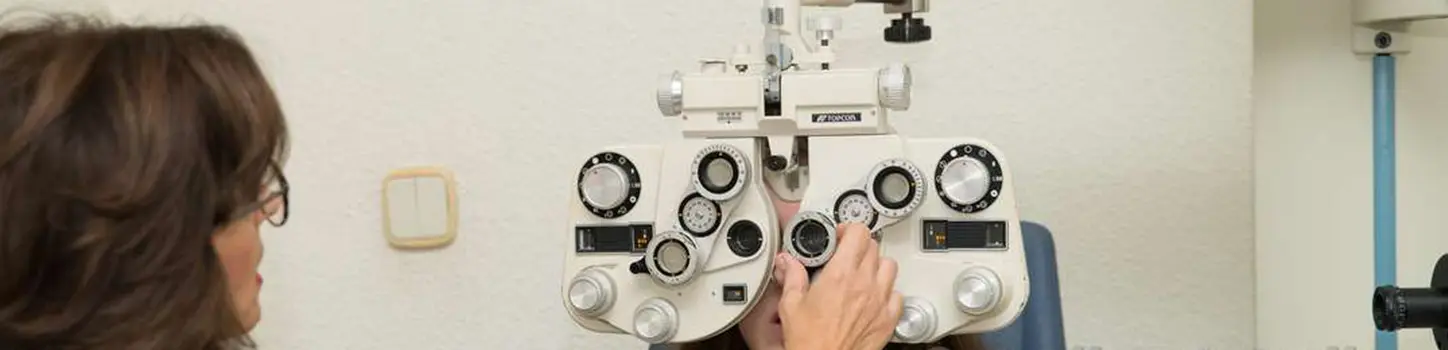
The prescription is the result, not the test
The figures that end up on your prescription come from a chain of measurements. First, how far each eye sits from its focal point. Then how the two of them share the work, which is what decides whether twenty minutes of reading leaves you with a headache.
On top of that comes intraocular pressure and a look at the eye, front and back. An eye that reads the bottom line can still have something worth watching, and the reverse holds too: middling vision is sometimes nothing more than a scratched lens.
We will ask you things that sound nothing like eyesight
How far away your screen sits. Whether you drive the coast road after dark. Whether you sew, whether you fish, whether you read in bed. How many hours you spend in the sun, and whether the air conditioning leaves your eyes dry by mid-afternoon.
Two people with identical prescriptions need different lenses depending on how they live. That half hour of conversation is the difference between spectacles that get worn and spectacles that end up in a drawer by the front door.
If you already wear spectacles, arrive in them
The first thing we do is measure them: what prescription they actually carry, how they are centred, and how they sit on your face. Comparing the pair you walked in with against the new measurement explains half the complaints that reach this counter.
Bring the prescription sunglasses and the reading pair as well, if you have several. They show what you use in practice, which is not always what you bought.
What you take away
Everything we measure goes on your record and is compared with last time. That run of readings over the years is worth more than any single measurement, and it belongs to you.
- Your prescription in writing, to take wherever you like
- Your intraocular pressure, alongside the reading from last time
- The measured prescription of the spectacles you already wear, and their condition
- A referral report for the ophthalmologist if one is warranted
- No obligation to buy anything, that day or ever
Common questions
Free? Where is the catch?
There is no catch and no small print. The examination is not charged for and commits you to nothing: if you decide to buy your spectacles elsewhere, you still walk out with your prescription in writing. We live on people coming back, not on charging for the first visit.
Can you tell me whether I have cataracts or glaucoma?
No. We can see signs and measure pressure, but the diagnosis belongs to an ophthalmologist. When we find something that warrants ophthalmological assessment we explain it, put it in writing and tell you who to take it to.
I had cataract surgery years ago. Does that change anything?
It does, so tell us when you arrive. An intraocular lens changes how several of the measurements are read, and it changes what makes sense to recommend afterwards. The same goes for laser surgery or any eye treatment you are still under.
Can I come in with my mother and stay with her?
It is the sensible thing, particularly if you are the one asking the questions. There is room for somebody with you, and the options are explained to both of you so that nobody leaves with half the story.
Is there anything I should bring?
The spectacles you use, and the name of any eye drops or medication you take. Some treatments dry the tear film or affect focusing, and knowing that changes what we will suggest.
The information on this site is for general guidance and does not replace a professional consultation. If you have symptoms, please see your optometrist, hearing aid audiologist or doctor.
